Car Circuit Probe Tester Explained: A UK Buyer's Guide
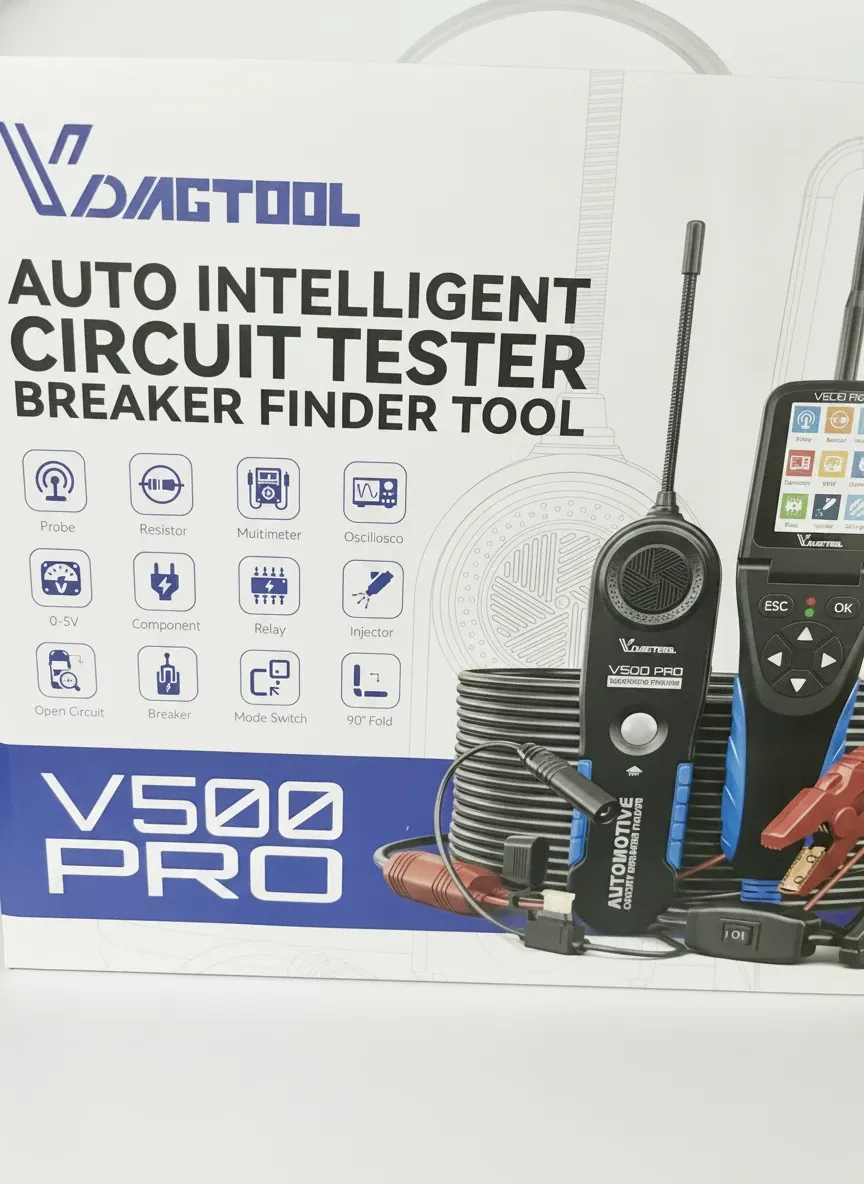
Short answer: a car circuit probe tester is an active diagnostic tool that does more than read voltage — it supplies battery power or earth to a component directly, so you can make a fan, relay, motor or injector work on the bench or in the loom without hotwiring. For a technician who currently carries a scope, a power probe and a multimeter between the ramp and the bench, it removes two tools from the trip.
Car circuit probe tester at a glance
- It is active: as well as measuring, it can power or ground a component to prove whether the part or the circuit is at fault.
- Powering a component directly removes the need to back-probe or bypass wiring for a quick functional test.
- A built-in circuit breaker matters — it protects the ECU and the wiring if you touch the wrong point.
- The most useful units add a waveform view, so the same probe that powers a part can also show its signal.
What is a car circuit probe tester?
It is a powered probe. Connect it to the battery and it can deliver a live feed or a ground through the probe tip, on demand, while also reading voltage and continuity. That single ability — to energise a component rather than just observe it — is what separates it from a multimeter or a test light, and it is why it has become the tool many auto electricians reach for first.
How do you use one?
Instant component activation
Suspect a cooling fan, a window motor, a fuel pump or a relay? Instead of building a temporary feed, you can apply power or ground straight from the probe and watch the component respond. If it runs when you power it directly but not in normal operation, the part is fine and the fault is upstream — a switch, a relay or the wiring. That one test saves a great deal of guesswork.
Rapid short-circuit testing
A probe tester with an integrated breaker finder helps isolate a short without repeatedly sacrificing fuses. It is the fast way to answer "which branch is pulling current?" — and for the full method, see our automotive short circuit finder guide.
Tracing open circuits and bad earths
Because it both measures and supplies power, the probe is well suited to finding a break in a run or a poor earth — the quiet cause behind flickering lights and modules that misbehave. You confirm supply at one end and continuity to the other, then check the earth path, all with one tool.
Why the built-in breaker matters
Feeding power into a modern loom is powerful and, without protection, risky. A built-in 10A auto-reset circuit breaker is the safeguard: if you touch the wrong terminal or create an accidental short while activating a component, the breaker trips and resets rather than letting current run into an ECU. For anyone powering injectors, fans and relays all day, that protection is not a luxury — it is the reason you can work quickly with confidence.
One probe instead of three tools
The appeal for a busy diagnostic technician is consolidation. A tool that measures voltage and resistance, activates components, and shows a waveform means the scope, the power probe and the meter stop being three separate items to fetch, connect and carry between the lift and the workbench. When the same probe that powers an injector can also display its PWM signal, an intermittent misfire or an odd sensor reading is far quicker to pin down.
Is a circuit probe tester better than a multimeter?
For functional testing, yes; for a precise standalone measurement, the multimeter still has its place. The probe wins whenever you need to do something to the circuit — energise a part, trace a short, prove an earth — rather than only read it. A tester that includes voltage and resistance modes gives you the meter's readings too, which is why an all-in-one probe suits day-to-day diagnostics. For the wider category and how it compares with a test light, see our automotive electrical circuit tester guide, and to match the tool to your type of work, our car electrical tester guide.
The CircuitTest UK V500 Pro as a probe tester
The CircuitTest UK V500 Pro is built for active diagnostics: it supplies power or ground through the probe to activate fuel injectors, cooling fans and relays without hotwiring, while a built-in 10A auto-reset circuit breaker protects the ECU. It reads voltage, resistance (0–100 kΩ) and current, includes an integrated breaker finder and wire tracer for shorts, and a built-in automotive oscilloscope (10 Hz–100 kHz) shows PWM, CAN bus, ABS and crank waveforms on its 2.4-inch TFT colour screen. It covers 9V–30V (12V and 24V) systems, ships with a 20 ft (6.1 m) extension cable, and is UKCA, CE, RoHS and WEEE marked. Price is £301.71 inc. VAT (£251.42 ex. VAT), with free UK next-day delivery, 30-day returns and a 12-month warranty with UK support.
Power a component and read its waveform on one probe
View the CircuitTest UK V500 Pro — £301.71Frequently asked questions
What does a car circuit probe tester do that a multimeter cannot?
It can supply power or ground to a component directly, so you can make a fan, relay or motor operate to test it. A multimeter only measures, so it cannot drive a part. The probe also traces shorts and open circuits actively, which is faster than measuring alone.
Is it safe to power components directly with a probe tester?
It is, provided the tool has protection. A built-in auto-reset circuit breaker trips if you create an accidental short or touch the wrong terminal, which protects the ECU and wiring. Always follow the vehicle maker's guidance, but the breaker is what makes rapid activation practical.
Can a car circuit probe tester find a short circuit?
Yes. With an integrated breaker finder it isolates the branch drawing current without repeatedly blowing fuses, so you can trace a persistent short or a parasitic drain methodically rather than by trial and error.
Does a probe tester replace an oscilloscope?
For everyday work, a probe with a built-in oscilloscope covers most needs, letting you view PWM, CAN and sensor waveforms on the same tool you use to power components. A dedicated bench scope still offers higher bandwidth for specialist analysis, but the combined tool handles the majority of jobs.
Ready to diagnose faults faster with CircuitTest UK?
Free UK next-day delivery · 30-day returns · 12-month warranty
Shop the V500 Pro Power Probe — £301.71